Why Your Coaching Business Stopped Scaling (And How Fulfillment Fixes It)

Why Scaling an Online Coaching Business Eventually Stops Working
At the beginning, growth feels simple.
You launch an offer.
You get clients.
Revenue goes up.
Then it slows down.
Not all at once — but enough to notice.
Leads get more expensive.
Sales become inconsistent.
Months start depending on performance instead of momentum.
Most coaches respond the same way:
They try to fix marketing.
New funnels.
New scripts.
New platforms.
But scaling an online coaching business doesn’t break at the front end.
It breaks in fulfillment.
The Real Reason Coaching Businesses Plateau
There’s a structural problem most people ignore.
Your business is built on one-time transactions.
A client joins.
They go through the program.
They leave.
Then you replace them.
That model works — until it doesn’t.
Because:
Your market is limited
Your audience gets saturated
Your offer loses novelty
At some point, you’re no longer growing.
You’re recycling demand.
And if your revenue depends on constantly acquiring new clients…
You don’t have a scalable business.
You have a fragile one.
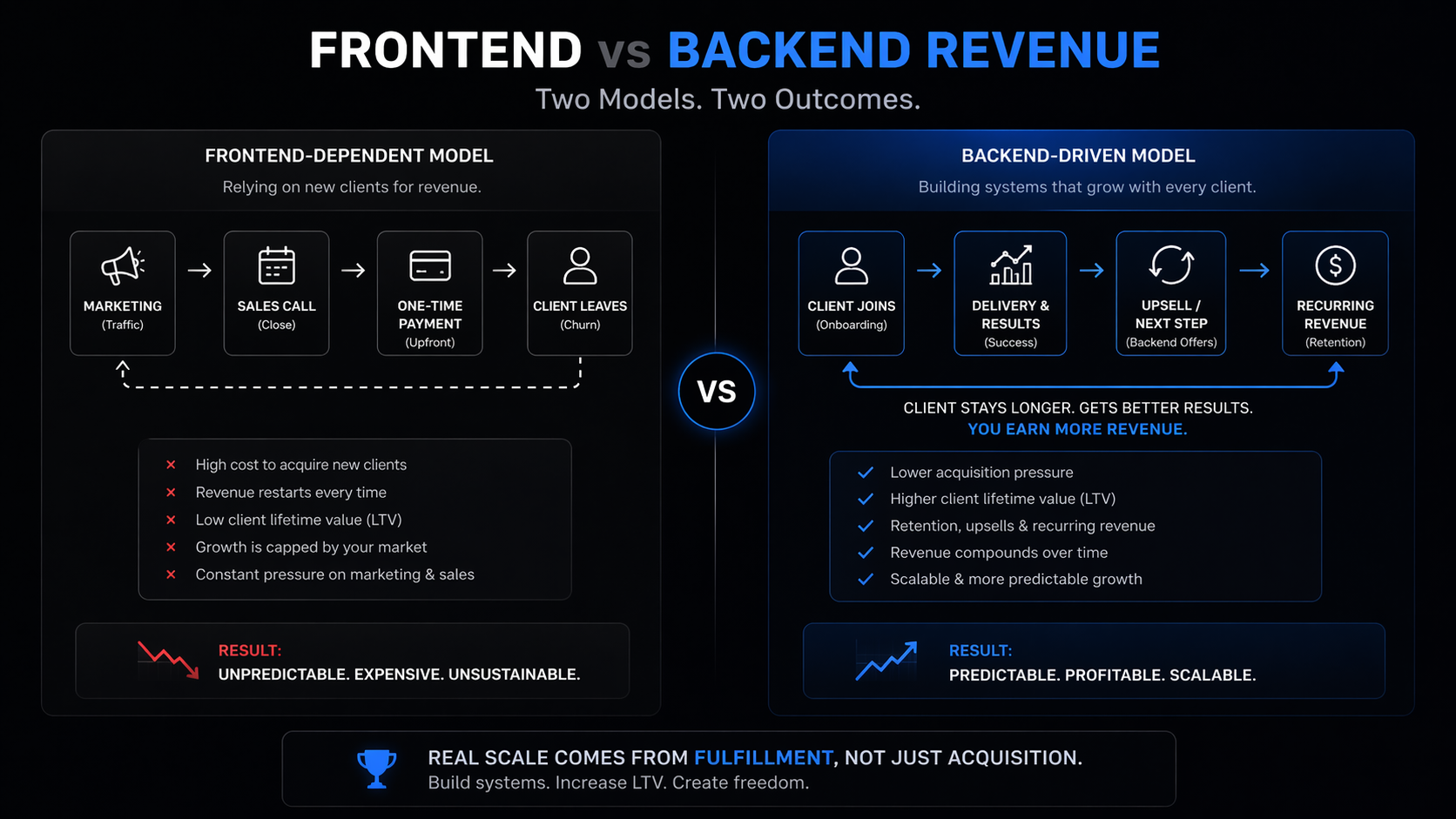
Frontend Growth vs Backend Growth (The Key Difference)
This is where the shift happens.
Most coaching businesses focus on:
Leads
Calls
Closings
That’s frontend growth.
But real scale comes from:
Retention
Client success
Upsells and recurring revenue
That’s backend growth.
And the difference between the two is everything.
Why One-Time Clients Kill Your Growth
Let’s break it down simply.
To get a client, you:
Spend money (ads, content, team)
Spend time (sales process)
And then you monetize them once.
After that?
Nothing.
No continuation.
No progression.
No second layer of value.
Which means:
You constantly restart revenue
Your margins stay compressed
Growth depends on constant performance
This is why most coaching businesses plateau between $50k–$150k/month.
Not because they can’t sell.
Because they don’t retain.
What Fulfillment Systems Actually Do
Fulfillment is not:
Calls
Content
Community
That’s delivery.
Fulfillment systems are what make delivery scalable.
They control:
How fast clients get results
How long clients stay
Whether clients trust you enough to continue
A strong fulfillment system turns your business into:
A system that grows from existing clients — not just new ones.
The 4 Systems That Actually Scale a Coaching Business
1. Onboarding That Creates Momentum
The first 72 hours determine everything.
If onboarding is:
Slow
Confusing
Overwhelming
Clients disengage early.
Strong onboarding:
Has 3–5 clear steps
Removes friction completely
Creates a quick win
Momentum beats motivation.
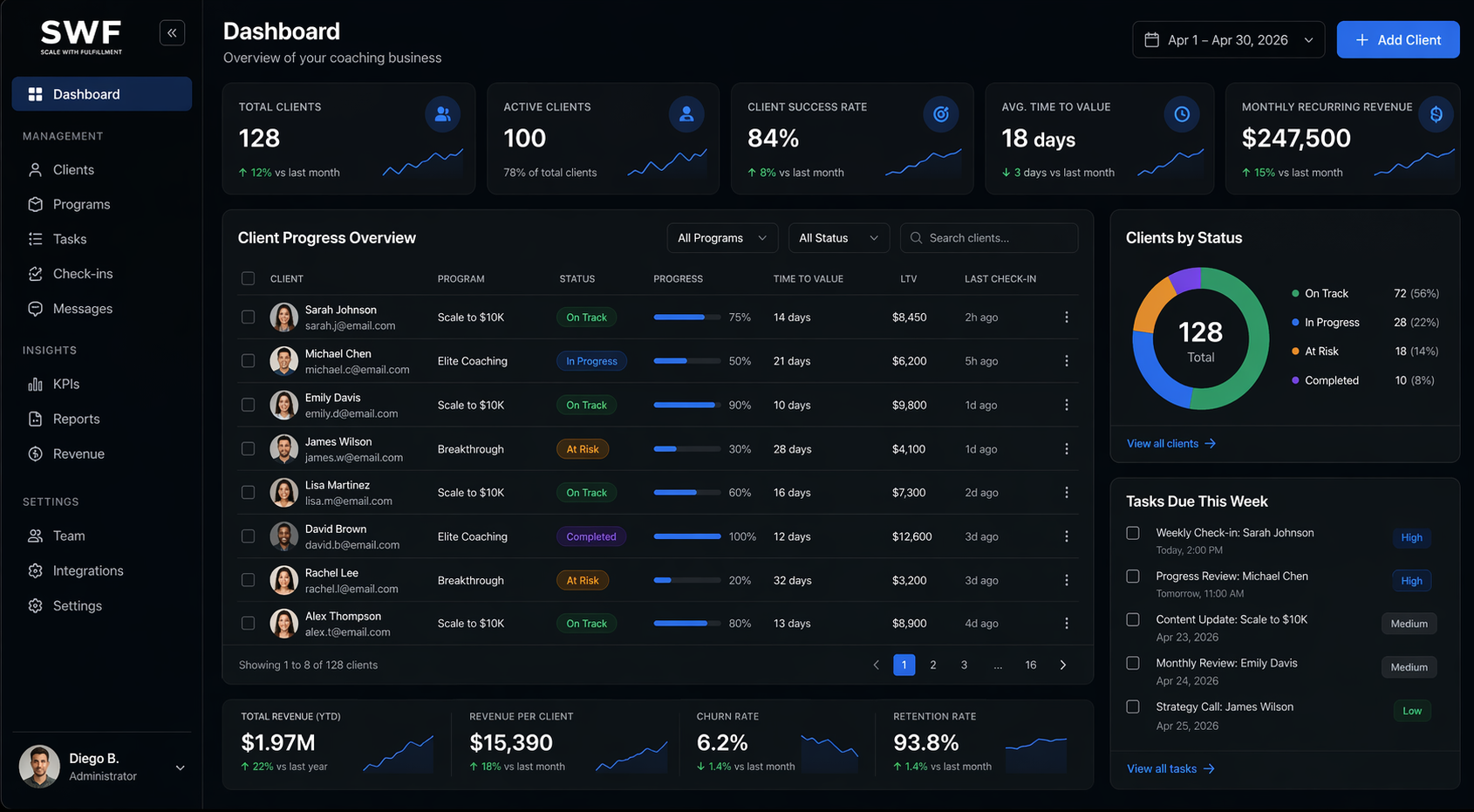
2. Client Tracking & Visibility
Most coaching businesses operate blind.
They don’t know:
Where clients are stuck
How long results take
Who is at risk of dropping off
Without tracking, improvement is random.
With tracking, patterns become clear.
3. Client Success Frameworks (Not Just Delivery)
Finishing a program isn’t success.
Getting a real result is.
And when clients get results, something important happens:
Their needs change.
That’s where most businesses fail.
They don’t evolve the client.
They stop at the first outcome.
4. Backend Monetization (LTV Expansion)
This is where scale actually happens.
Instead of:
Client → Done
You build:
Client → Result → New Need → Next Offer
This creates:
Higher lifetime value (LTV)
More predictable revenue
Less dependency on new leads
Scaling a coaching business without backend monetization is almost impossible long-term.
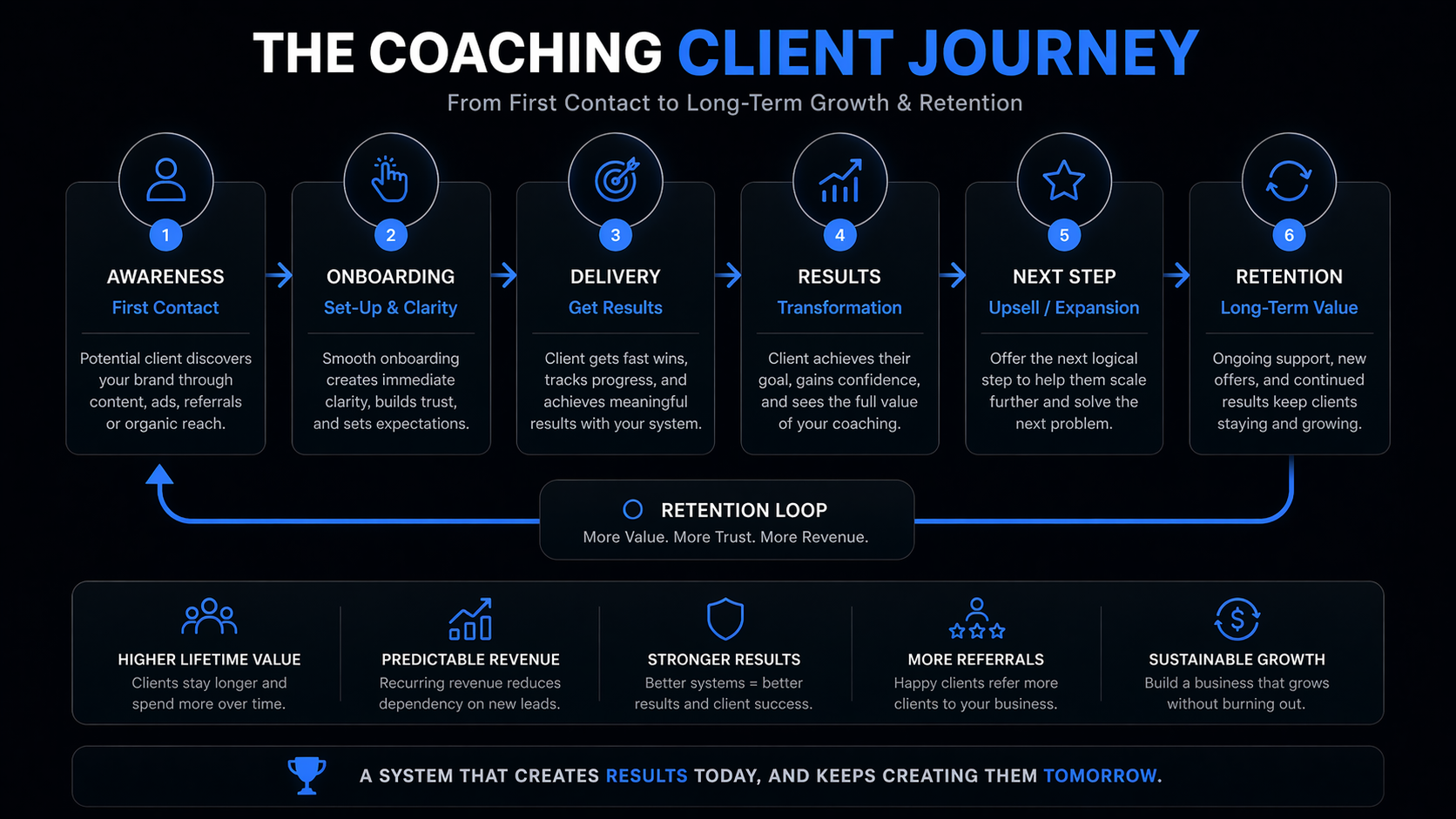
Why Retention Is the Real Growth Lever
Most coaches try to scale by increasing volume.
More leads.
More calls.
More sales.
But volume alone doesn’t create stability.
Retention does.
When clients:
Stay longer
Get better results
Continue buying
Your business stops resetting every month.
It starts compounding.
Common Mistakes That Kill Coaching Fulfillment
Treating fulfillment as an afterthought
Having no upsell or continuation path
Poor onboarding experience
No tracking or KPIs
Weak or disconnected team structure
Fix these, and most scaling problems disappear.
What a Scalable Coaching Business Actually Looks Like
At scale, your business is structured.
Clients:
Move through clear stages
Are tracked consistently
Have defined next steps
Your team:
Knows their role
Executes consistently
Your revenue:
Doesn’t rely only on new clients
That’s when growth becomes predictable.
FAQ: Scaling a Coaching Business
Why does my coaching business stop growing?
Most coaching businesses plateau because they rely on new clients instead of retention. Without backend systems, revenue resets every cycle.
How do you scale a coaching business without more leads?
By increasing client lifetime value through better fulfillment, retention systems, and backend offers.
What is LTV in a coaching business?
LTV (lifetime value) is the total revenue generated from one client over time, including upsells and renewals.
How can I reduce churn in my coaching program?
Improve onboarding, track client progress, and create a clear next step after clients achieve their first result.
Final Thought
Scaling an online coaching business isn’t about pushing harder on sales.
It’s about building systems that make every client more valuable.
Because when your fulfillment works:
You don’t need constant growth to survive.
Growth becomes the natural result.